
A 2D Handle
10/11/2022
2D meaning two degrees of freedom: translation and rotation. Functional prototype:
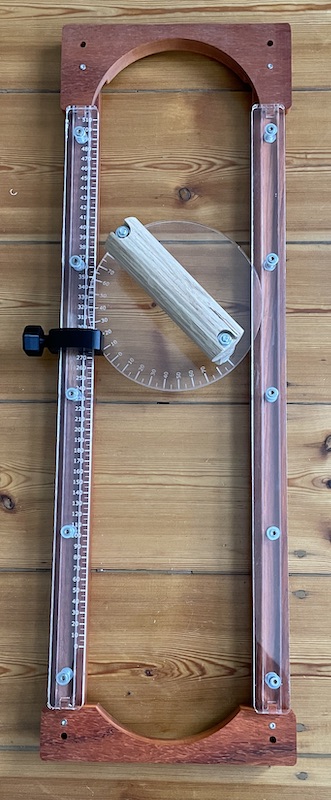
The photo below shows the POC (Proof Of Concept) validating the innovative offset-pressure locking system for translation and rotation—right on the slide, left on the cursor (white 3D-printed part visible on the left slide above). This 2D handle is for vertical installation; its weight bears on the cursor corner, increasing friction on the slides. The device’s idea draws from the "foot-hand opposition" technique in climbing.
Physically, as the handle is stationary, the sum of forces is zero. In the diagram below, this means the weight (black) is balanced by the sum (violet) of the right edge reaction (green) and cursor reaction (red).
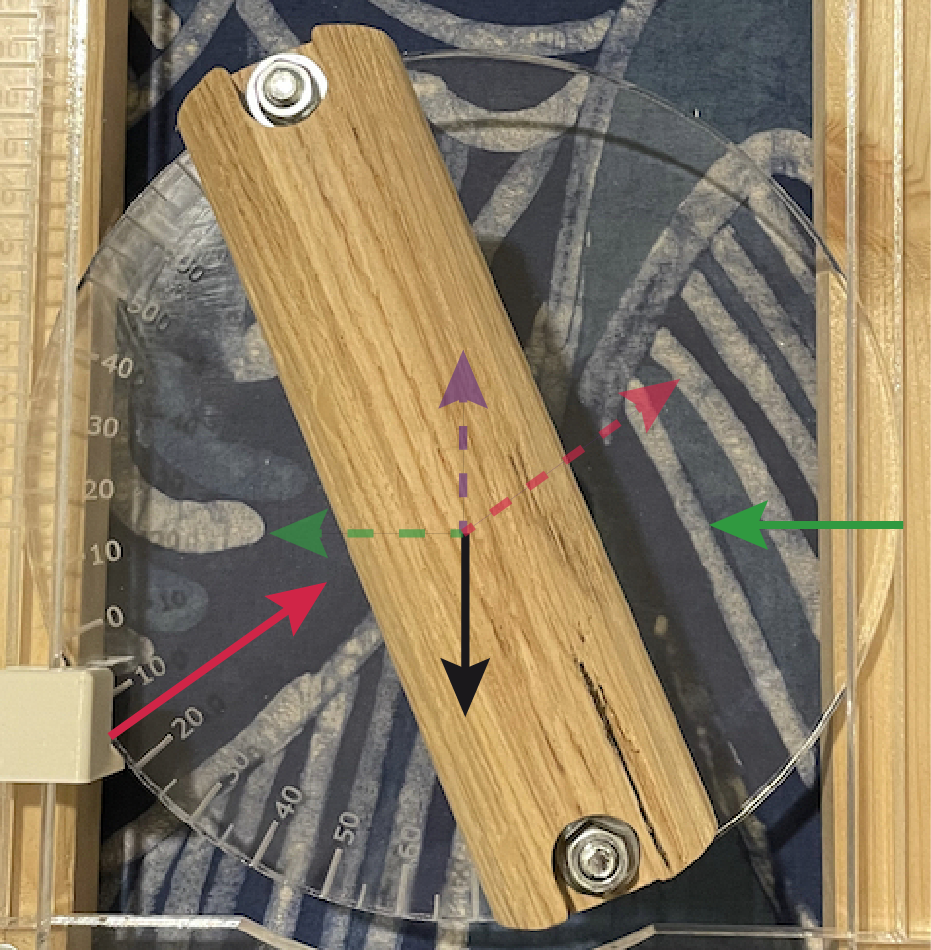
Seen this way, it’s much clearer, right? :-)
Other details of this 2D handle’s design may go unnoticed.
For example, the handle’s cross-section is an octadecagon (regular, of course). Choosing an 18-sided polygon over a cylinder improves grip. And 18 because it’s 360/20 (obviously).
More visible yet subtle, the handle ends’ sections aren’t flat but follow a circle concentric to the attached disk’s projection. More than pleasing design, this aligns them with the handle supports’ profiles, necessary for rotation…
All good, but it doesn’t answer the key question: what’s it for?
As a fixed point for physical therapy exercises to repair a shoulder with off-center humeral head or, preventively, avoid off-centering.
Why control two degrees of freedom for this handle?
Translation adapts to user size and desired pull angle. Rotation controls the angle for pulling on the handle.
The graduations are a simple reference for progression or reproducing session contexts.